
 Letters spacing
 Line height
 Default
 Big
Big More big
 Default
 Black & White
Building Wealth How the Gulf is powering artificial intelligence

srchThumbnail:/en/Images/anchoring-the-ai-future-200x200_tcm41-590577.webp
From oil barrels to graphics processing unit clusters: The Gulf Cooperation Council’s bid to anchor the artificial intelligence century
Artificial intelligence (AI) is no longer a distant innovation. It is quietly becoming the operating system of modern economies, shaping how money moves, how patients are treated, how goods arrive and how knowledge is shared. Its influence is spreading at remarkable speed. Yet behind every intelligent application sits a reality that is far more physical than digital.
Artificial intelligence runs on energy, space and infrastructure. It requires vast computing facilities, uninterrupted power, advanced cooling systems and capital willing to wait for long‑term returns. Ideas may spark progress, but it is these physical foundations that determine how far and how fast artificial intelligence can scale. This is precisely where the Gulf Cooperation Council (GCC) enters the global story.
Long synonymous with oil production, the region is now rewriting its economic narrative. Abu Dhabi, Dubai and Riyadh are not seeking to outcode established technology hubs. Instead, they are tackling the world’s most pressing artificial intelligence constraint: the shortage of dependable, affordable computing capacity. By combining abundant energy, available land, rapid execution and deep pools of capital, the Gulf is positioning itself as one of the most critical enablers of the artificial intelligence age.
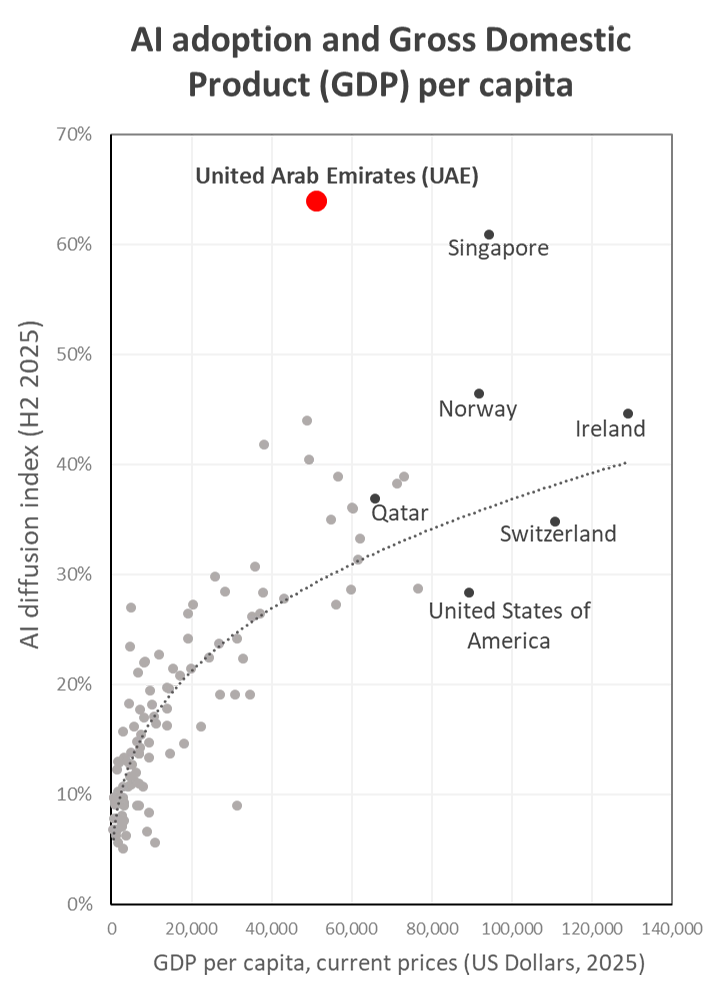
United Arab Emirates (UAE) punching above its weight in AI ambitions
Why artificial intelligence has become an infrastructure challenge
Building advanced artificial intelligence is no small undertaking. It is an industrial-scale endeavour. Behind every breakthrough model sit thousands of graphics processing units (GPU) running day and night, drawing enough electricity to power entire neighbourhoods. Add the constant need for cooling, redundancy and resilience and artificial intelligence quickly becomes one of the most energy‑hungry activities in the modern economy. This is where ambition meets reality.
Across many Western markets, the physical demands of artificial intelligence are colliding with hard limits. Power grids are stretched, energy costs fluctuate sharply, suitable land is increasingly scarce and approval processes can take years. As a result, progress is no longer slowed by a lack of ideas, but by an inability to build fast enough. Infrastructure, not innovation, has become the true bottleneck to artificial intelligence expansion.
The GCC faces this challenge from a very different starting point. Energy supply is plentiful, land is available at scale and infrastructure planning is anchored in long-term national strategies rather than short-term market pressures. This alignment allows the region to move decisively, turning capacity constraints elsewhere into a competitive advantage at a moment when the world is racing to secure the foundations of artificial intelligence.

Why infrastructure has become decisive?
The next chapter of artificial intelligence growth is being unlocked by the ability to build at scale. As computing demand surges, power availability, land access and project execution speed have become the true scarce resources.
- In many mature markets, grid strain, rising energy costs and lengthy approvals are slowing deployment
- Regions able to deliver large‑scale capacity quickly are emerging as strategic enablers, not just technology adopters
- The Gulf’s combination of abundant energy, scalable land and long‑term planning turns physical constraints elsewhere into a structural advantage
The focus is broadening from digital innovation to the physical foundations that support the artificial intelligence economy.
Geography as a competitive advantage
Artificial intelligence infrastructure rests on two decisive foundations: uninterrupted power and scalable space. Few regions can offer both in abundance. The Gulf stands apart.
Across parts of the region, industrial electricity costs remain materially below those of Europe, the United Kingdom and North American coastal markets. This advantage is not accidental. It is reinforced by large‑scale renewable energy programmes, particularly solar and by state‑aligned utilities capable of synchronising power generation with the rapid expansion of data centre capacity. The result is an energy environment designed not merely for today’s demand, but for decades of intensifying compute requirements.
Land availability provides the second pillar. While established technology corridors grapple with zoning constraints, land scarcity and community opposition, Gulf cities benefit from vast expanses of developable terrain. This allows data centres to be designed as true campuses, supporting multi‑gigawatt capacity and long‑term expansion from day one, rather than piecemeal additions over time.
For artificial intelligence operators planning far beyond the next product cycle, these conditions offer something increasingly rare in the global technology landscape: cost predictability, operational certainty and the confidence to scale without constraint.
Capital as a strategic asset
Artificial intelligence is often described as a digital revolution, but it's true foundation is unmistakably physical. Long before software can scale, capital must be committed to concrete and steel, power generation, cooling systems and grid connectivity. In the artificial intelligence economy, infrastructure is the real point of entry.
This is where the GCC holds a decisive advantage. Across the region, sovereign investment institutions are deploying long‑term capital into artificial intelligence infrastructure, computing platforms and the industries that enable them. These commitments are not short‑term financial bets. They form part of broader national strategies to diversify economies, build future‑proof capabilities and secure lasting relevance beyond hydrocarbons.
Execution speed further sets the region apart. In many Gulf markets, permitting and approvals are measured in months rather than years. Special economic frameworks can integrate land access, power allocation and infrastructure planning into a single, coordinated pathway. For global technology partners facing an urgent shortage of computing capacity, this ability to move quickly has become just as valuable as cost, turning speed itself into a strategic asset.
Building talent alongside infrastructure
Infrastructure alone does not create a thriving artificial intelligence ecosystem. Talent is the essential catalyst. Recognising this, Gulf states are investing as deliberately in people as they are in power plants and data centres.
Across the region, specialised universities dedicated entirely to artificial intelligence, national upskilling initiatives and expanded technical curricula are building a deepening pool of local expertise. These efforts are complemented by immigration reforms and long‑term residency programmes designed to attract experienced professionals from global technology centres, strengthening knowledge transfer and accelerating capability development.
The impact of this dual focus is already visible. Adoption rates suggest that infrastructure investment is being matched by real‑world use and demand. The United Arab Emirates, for instance, ranks among the world’s highest in artificial intelligence usage per capita, signalling that the region is not only building the foundations of artificial intelligence, but actively embedding it into everyday economic and professional life.
Constraints and considerations
Despite strong momentum, the Gulf Cooperation Council’s artificial intelligence ambitions are shaped by several practical considerations. As infrastructure scales, understanding these factors helps set realistic expectations about how growth may unfold over time.
- Water intensity and sustainability
Artificial intelligence data centres require substantial volumes of water for cooling. In a water‑scarce region, reliance on desalination raises questions around long‑term cost efficiency, environmental sustainability and the scalability of large compute campuses. - Semiconductor supply dependence
Advanced semiconductor manufacturing remains concentrated outside the region. While strategic partnerships provide access to cutting‑edge hardware, global supply chains remain exposed to geopolitical developments and regulatory constraints beyond regional control. - Competing demands on sovereign capital
Sovereign investment resources must be balanced across multiple national priorities, including housing, tourism and broader industrial diversification. These trade‑offs may influence the pace and depth of artificial intelligence infrastructure investment over time.
These considerations do not weaken the region’s strategic proposition. Instead, they highlight the complexity of building artificial intelligence at scale and underline the importance of disciplined planning, technological adaptation and long‑term policy alignment as the Gulf positions itself at the centre of the artificial intelligence century.
Key factors to watch
- How cooling technologies and water‑efficient designs evolve to reduce long‑term operating intensity.
- The resilience of global semiconductor supply chains amid shifting geopolitical and regulatory landscapes.
- Signals on how sovereign capital is prioritised between artificial intelligence infrastructure and other strategic development initiatives.
Together, these factors will shape not only the speed of deployment, but the durability of the region’s role in the global artificial intelligence ecosystem.
What this shift means for investors
For affluent investors, the artificial intelligence opportunity in the Gulf extends far beyond headline‑grabbing technology names. The real story lies beneath the surface, in the systems that make artificial intelligence possible at scale.
The most durable growth often sits in the enabling layers: power generation and transmission, water and cooling infrastructure, thermal management solutions, specialised engineering and grid interconnection. These are not peripheral industries. They are the essential foundations without which artificial intelligence cannot operate, regardless of how advanced the software becomes.
By understanding this wider ecosystem, investors can look past short‑term innovation cycles and focus on long‑term structural demand. In a world where computing power is increasingly scarce, the greatest opportunities may lie not in the algorithms themselves, but in the infrastructure that keeps them running.
A new role in the global artificial intelligence economy
The Gulf Cooperation Council is not attempting to mirror established technology centres. Instead, it is defining a complementary and increasingly essential role: building the physical backbone that allows artificial intelligence to scale globally. By aligning energy advantage, patient sovereign capital, regulatory agility and long‑term talent development, the region is positioning itself as a critical enabler of the artificial intelligence economy. In a world where computing power is fast becoming a measure of economic competitiveness, this shift marks one of the most consequential transformations in the Gulf’s modern evolution, with implications that will resonate well beyond the digital realm.
Glossary
For Glossary of terms, abbreviations and explanations on investments, please visit adcb.com/invglossary.
Wealth Management solutions
Discover reliable, innovative Wealth Management solutions. Learn more.
Disclaimer
ADCB’s products and services are subject to Consumer Banking Terms and Conditions. Abu Dhabi Commercial Bank PJSC ("ADCB", "The Bank") is licensed by the Central Bank of the United Arab Emirates under license number 13/2461/2005 to provide banking services to its clients, and by the Securities and Commodities Authority to promote investment securities and provide investment related services under license number 601001.
This webpage is for information and illustrative purposes only and does not constitute any form of advice, commitment or engagement on behalf of the Abu Dhabi Commercial Bank and any of its subsidiaries including ADCB Asset Management Limited ("ADCB Group"). It should not be construed as an offer or solicitation to buy or sell any investment products, nor is it to be considered as personalized investment advice. It should be read in conjunction with applicable documents and respective terms and conditions for potential investor to understand the terms and information contained therein. Persons viewing this page are instructed to discuss it with their professional legal, financial and tax advisors before they make any financial commitments and shall be deemed to have made a reasonable assessment of the potential risks and rewards in making such a commitment. ADCB Group does not guarantee any third party service provider, and investors invest at their own risk and bear all risks involved in any product purchased. ADCB Group will not hold any responsibility for the outcome of any investment decisions taken. Past performance does not guarantee future results. Investment products are not Bank deposits and are not guaranteed by the ADCB Group, they are subject to investment risks, including possible loss of the principal amount invested. Please refer to ADCB Wealth Services Terms and Conditions and/or to ADCB Asset Management Limited Terms and Conditions.

Did you know?Why artificial intelligence needs the Gulf
Artificial intelligence is no longer limited by ideas, but by energy, land and infrastructure. The Gulf Cooperation Council offers all three at scale. With low-cost power, fast approvals and long-term capital, the region is becoming essential to how artificial intelligence systems are built, trained and operated globally.
Knowledge quiz Why is artificial intelligence increasingly limited by infrastructure rather than ideas?
Tags: Nearing Retirement Entrepreneurs Growing Your Savings Growing Your Business Investing for Growth

