
 Letters spacing
 Line height
 Default
 Big
Big More big
 Default
 Black & White
Building Wealth Embracing ESG creates new opportunities for UAE businesses

srchThumbnail:/en/Images/esg-200x200_tcm41-554671.webp
The sustainability revolution reflects a changing attitude among investors and consumers who prefer to engage with companies that share their values. Environmental, Social, and Governance (ESG) factors have emerged as new pathways for companies to evaluate their environmental impact, sustainability, and good corporate citizenship in their places of operation.
ESG focuses on how businesses address environmental concerns such as carbon emissions and resource efficiency; social issues, including community impact and employee relations; and governance standards, such as transparency, board diversity, and ethical practices. With growing awareness of climate change, social justice, and corporate accountability. ESG frameworks help stakeholders understand how a company’s operations affect society and the environment and how sustainably it can operate in the long term.
The United Arab Emirates (UAE’s) commitment to net zero emissions by 2050 and Abu Dhabi’s dedicated climate change strategy, as two examples, highlight how the Gulf region is adapting to these ESG considerations. Voluntary ESG disclosure guidelines from the Abu Dhabi Securities Exchange (ADX) also injects a sense of good corporate behaviour, creating companies that are mindful of their role in society, the environment, and the communities.
ESG factors explained
Environmental
The environmental aspect of ESG centres on a company’s impact on the environment, such as its carbon footprint, waste management, water conservation, and energy usage. Businesses adopting ESG principles are urged to minimise their environmental impact through sustainable practices, like reducing emissions, transitioning to renewable energy, and conserving resources. These measures are becoming essential in the face of escalating climate risks and stricter environmental regulations. For instance, initiatives such as the UAE’s Net Zero 2050 are pushing for renewable energy adoption and emissions reduction.
Social
Social factors consider a company’s commitment to corporate social responsibility (CSR), including labour practices, employee health and safety, community engagement, and diversity initiatives. A socially responsible business not only supports its workforce, but also invests in community well-being and social equity. Today, an increasing number of consumers and investors expect companies to uphold high standards in this area. In the UAE, companies are progressively incorporating social factors into their ESG strategies, often through community programmes, gender diversity efforts, and employee welfare schemes, reflecting a shift in cultural expectations and global standards.
Governance
Governance in ESG focuses on corporate governance structures, including transparency, accountability, board diversity, and ethical business practices. Strong governance frameworks protect shareholders’ rights, prevent fraud, and ensure corporate accountability.
A growing global importance
As climate change and social justice issues rise to the forefront of public concern, ESG factors have gained significant traction, which also led to a shift in investor behaviour.
A Deloitte study on ESG investing noted significant growth in the proportion of investors establishing sustainable investment policies, with 79% of them reporting having a policy in place, up from only 20% five years ago. Nearly all other investors report having a “loosely defined ESG investing policy” in place or have plans to develop a sustainable investment policy, with only 1% reporting no plans for a policy.
The changing regulatory landscape has also made room for ESG disclosures. Governments and regulators worldwide are introducing regulations to standardise ESG reporting, making transparency and accountability mandatory for many companies. In the European Union, for example, the Corporate Sustainability Reporting Directive (CSRD) mandates ESG reporting for certain firms, while the United States Securities and Exchange Commission (SEC) is working on proposals for mandatory climate risk disclosures. This push towards regulation ensures that ESG practices are not merely voluntary, but integral to corporate compliance.
Consumers are also increasingly favouring brands that align with their values, and this shift has prompted businesses to enhance their ESG initiatives. According to management consultancy PwC, 80% of consumers globally say sustainability is important to them, and more than half are willing to pay a 9.7% premium for sustainable products.
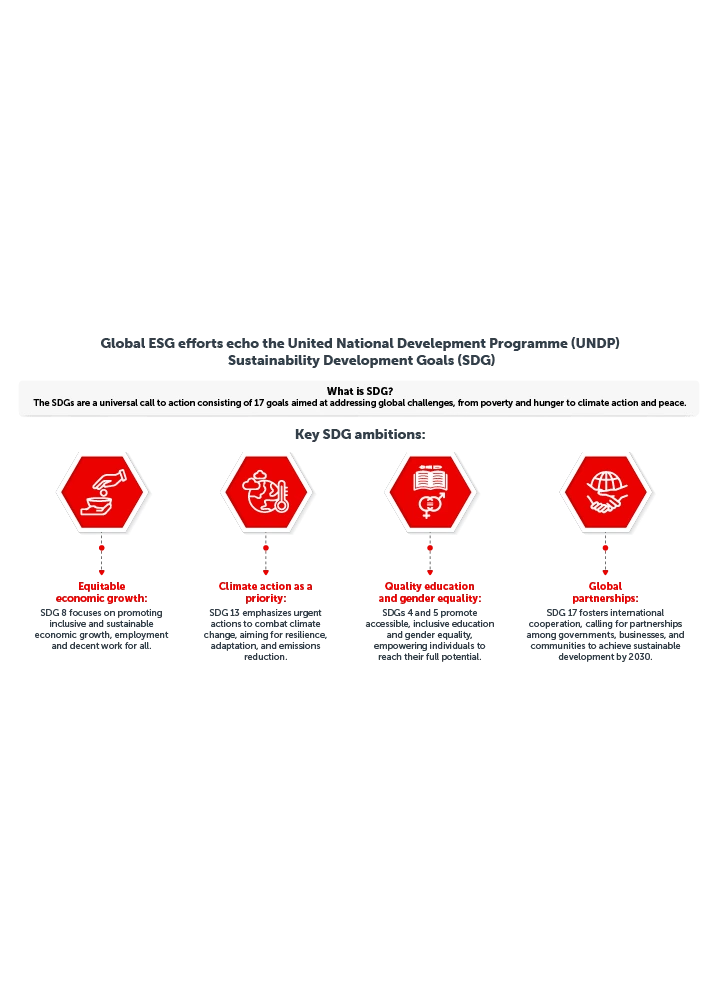
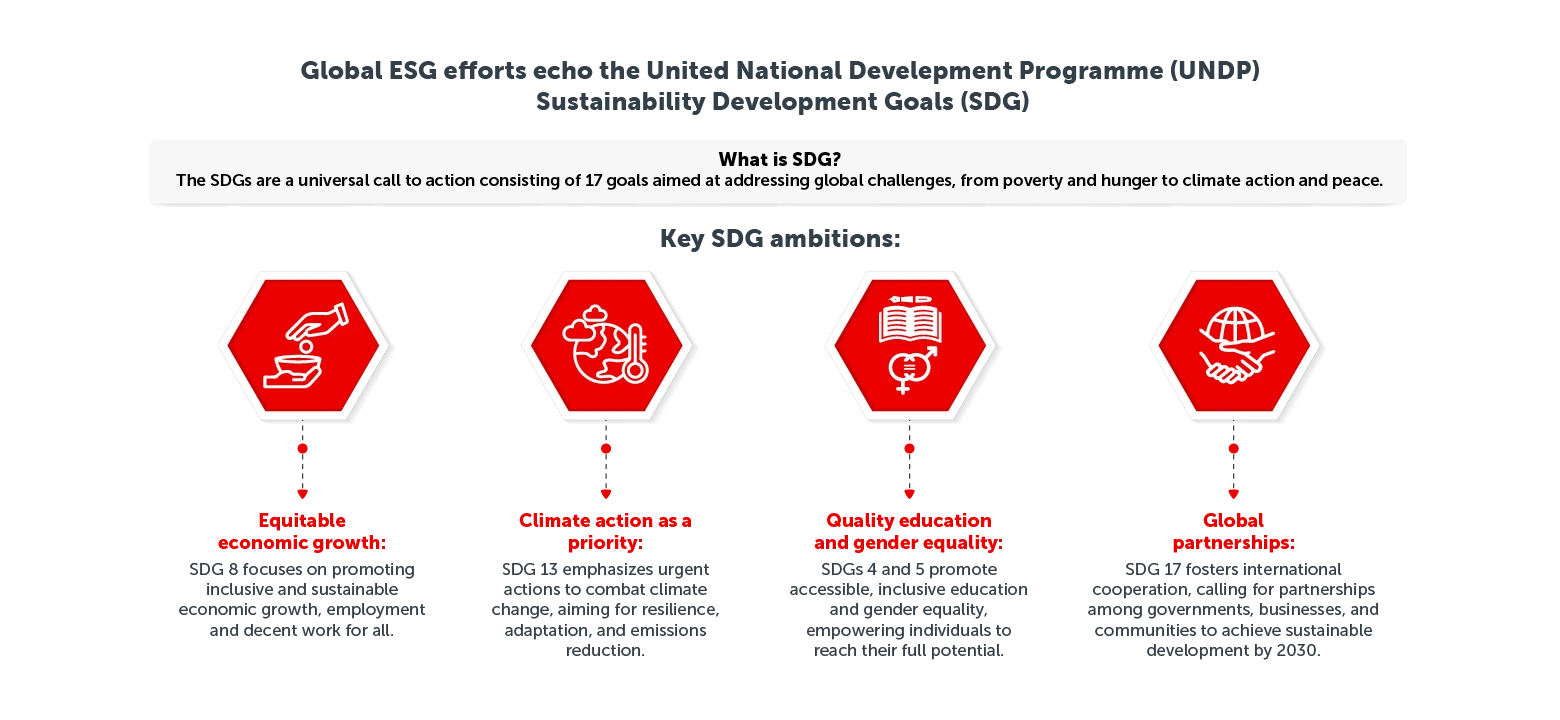
A new climate hub
The Global Climate Finance Centre (GCFC) in Abu Dhabi, announced during the 2023 United Nations Climate Change Conference (COP28) in 2023 in Dubai, is an ambitious initiative aimed at addressing the pressing global financing gap for climate action. Based in the UAE’s capital, this centre positions Abu Dhabi as a hub for mobilizing and deploying climate finance to accelerate decarbonisation and sustainable development worldwide.
The GCFC seeks to bring together public and private sector stakeholders, multilateral development banks, philanthropic organizations, and international investors to create innovative solutions for climate finance.
By leveraging Abu Dhabi’s strategic location and the UAE’s growing role in energy transition leadership, the centre focuses on enabling both regional and global collaborations.
GFCF is particularly geared toward addressing challenges faced by developing countries and vulnerable economies, which often struggle to access affordable financing for climate mitigation and adaptation projects. It aims to streamline the flow of capital into critical areas like renewable energy, climate resilience infrastructure, and low-carbon technologies.
A key focus of the GCFC is the development of developing sustainable finance structures, models that combine public and private funding to reduce risks and make climate investments more attractive to institutional investors. It also emphasizes capacity-building initiatives, helping countries strengthen their ability to implement sustainable climate solutions.
Through its activities, the GCFC underscores the UAE’s commitment to sustainability, particularly as the country transitions toward net-zero emissions by 2050. The GCFC hosts the secretariat for several major CCOP28 initiatives, including the Global Climate Finance Framework, which engages global forums to ensure climate finance commitments. It also hosts the Innovate for Climate-Tech Coalition (I4C) initiative, which aims to accelerates climate-tech solutions in the Global South through its 50-plus members.
The future of ESG
As the global economy changes and economic priorities shift, ESG frameworks are poised to reflect the shifting dynamics of the global economic environment, particularly as the world navigates macroeconomic challenges, regulatory changes, and growing scrutiny of sustainable finance. The UAE, as a financial and commercial hub and strong climate commitments, is ideally placed to advance ESG frameworks in the region.
Related resources
Building blocks of goodcorporate citizenship
Glossary
For Glossary of terms, abbreviations and explanations on investments, please visit adcb.com/invglossary.
Wealth Management solutions
Discover reliable, innovative Wealth Management solutions. Learn more
Disclaimer
ADCB’s products and services are subject to Consumer Banking Terms and Conditions. Abu Dhabi Commercial Bank PJSC ("ADCB", "The Bank") is licensed by the Central Bank of the United Arab Emirates under license number 13/2461/2005 to provide banking services to its clients, and by the Securities and Commodities Authority to promote investment securities and provide investment related services under license number 601001.
This webpage is for information and illustrative purposes only and does not constitute any form of advice, commitment or engagement on behalf of the Abu Dhabi Commercial Bank and any of its subsidiaries including ADCB Asset Management Limited ("ADCB Group"). It should not be construed as an offer or solicitation to buy or sell any investment products, nor is it to be considered as personalized investment advice. It should be read in conjunction with applicable documents and respective terms and conditions for potential investor to understand the terms and information contained therein. Persons receiving this email are instructed to discuss it with their professional legal, financial and tax advisors before they make any financial commitments and shall be deemed to have made a reasonable assessment of the potential risks and rewards in making such a commitment. ADCB Group does not guarantee any third party service provider, and investors invest at their own risk and bear all risks involved in any product purchased. ADCB Group will not hold any responsibility for the outcome of any investment decisions taken. Past performance does not guarantee future results. Investment products are not Bank deposits and are not guaranteed by the ADCB Group, they are subject to investment risks, including possible loss of the principal amount invested. Please refer to ADCB Wealth Services Terms and Conditions and/or to ADCB Asset Management Limited Terms and Conditions.

Did you know?ESG ratings and investment decisions
Knowledge quiz What do ESG ratings evaluate?
Tags: Working Professional Nearing Retirement New to UAE Financial Protection Retirement Planning Getting Financially Aware Investing For Growth

