
 Letters spacing
 Line height
 Default
 Big
Big More big
 Default
 Black & White
Building Wealth How space became part of everyday economic life

srchThumbnail:/en/Images/investing-space-economy-200x200_tcm41-594323.webp
From science fiction to financial reality
Space is no longer a remote scientific ambition. It has become an integral part of modern economic life. Everyday activities such as digital payments, navigation, weather forecasting, logistics and global communications rely on space‑based infrastructure. What was once dominated by national governments is now shaped increasingly by commercial innovation and private investment.
This shift has transformed the space sector into a broad economic ecosystem rather than a narrow scientific field. For affluent investors, this evolution presents a long‑term thematic opportunity linked to infrastructure, data, security and global connectivity.
What the space economy really includes
The space economy extends well beyond rockets and astronauts. It can be understood through two interconnected layers.

The first is the core space infrastructure, which includes satellite manufacturing, launch services and space operations. These activities form the physical foundation that allows space systems to function.

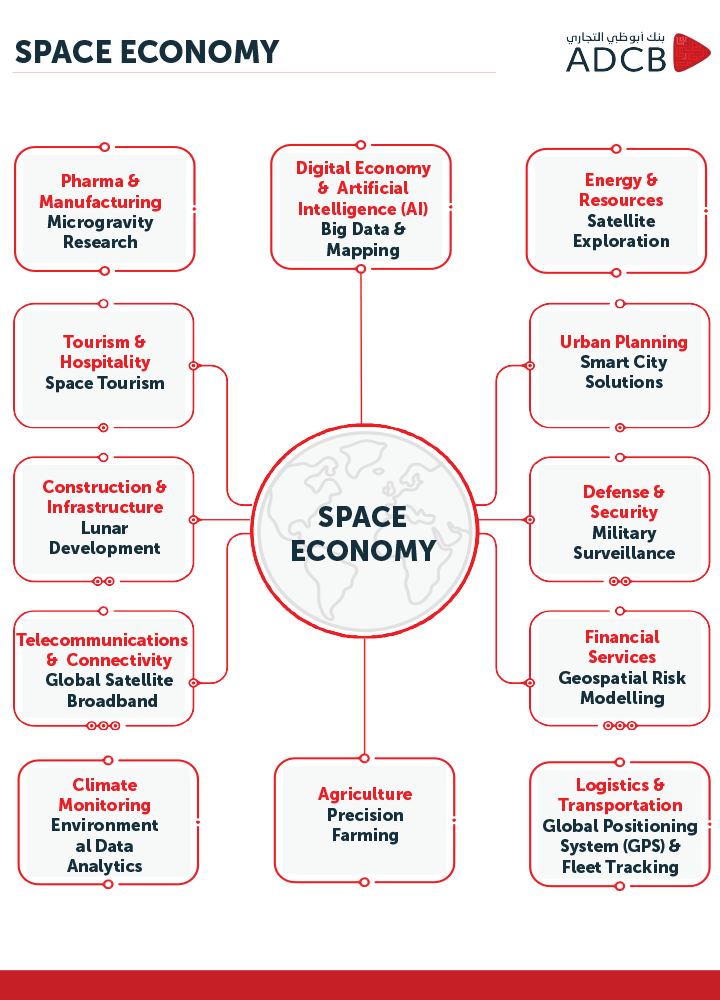
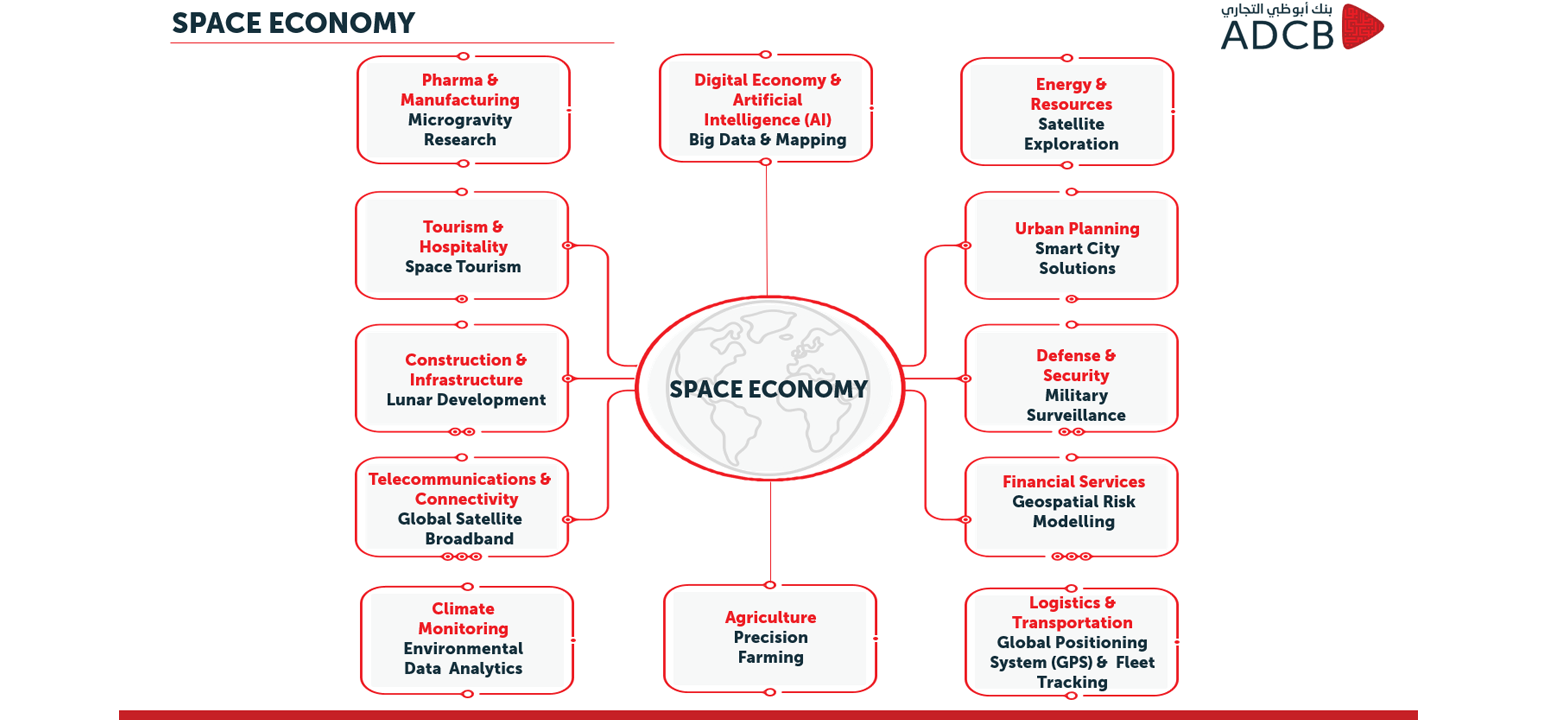
The second layer is the extended economic reach, covering industries that depend on space‑enabled data and services. These include logistics and navigation services, climate monitoring, agricultural planning, insurance risk modelling and financial market operations. While less visible, these reach activities increasingly represent the majority of economic value generated from space. This structure highlights why space investment is relevant even for investors with no intention of backing rocket launches directly.
Exhibit: Space economy and its “reach” sectors

Why growth is accelerating?
Several long‑term forces are driving rapid expansion across the space economy.
One key factor is the sharp reduction in launch costs. Reusable launch technologies have made access to space more affordable and frequent, allowing satellites to be deployed at scale. This has improved commercial viability and shortened development cycles.
Another driver is the growing demand for global connectivity. Satellite broadband networks are expanding internet access to remote and underserved regions, supporting digital inclusion and creating recurring revenue models.
Earth‑observation technologies are also gaining importance. Modern satellites now generate high‑quality, real‑time data that supports climate monitoring, disaster response, urban development and agricultural optimisation. As climate‑related financial risks grow, this data has become increasingly valuable to governments, insurers and businesses. Geopolitical priorities further reinforce investment. Space capabilities are now viewed as essential to national security, technological independence and economic resilience, supporting sustained public and private spending.
Commercialisation has changed the risk profile
In the past, space projects were associated with high uncertainty, long timelines and dependence on government budgets. This picture has changed significantly.
Commercial activity now accounts for the largest share of growth in the space economy. Private companies operate alongside public agencies, often supported by long‑term service contracts and diversified revenue streams. This reduces reliance on individual government programmes and improves income visibility.
Many space‑related businesses benefit from high barriers to entry, complex engineering requirements and specialised intellectual property. While this can support durable competitive positions, it also increases operational complexity and underlines the need for informed, disciplined investment decisions.

Where investors are seeing opportunities
Opportunities within the space economy span multiple segments, each offering different risk and return characteristics.
- Diverse and differentiated segments
The space economy spans multiple investment segments, each with distinct risk profiles, return characteristics and maturity levels, allowing for selective and diversified exposure. - Satellite communications and broadband services
One of the largest and most established areas of activity, this segment often benefits from subscription‑based or long‑term contractual revenue models. These structures can support predictable cash flows as global demand for connectivity continues to expand. - Launch services and space access technologies
Ongoing improvements in efficiency, reliability and reusability are reshaping launch economics. Increasing launch frequency underpins growth across the wider space ecosystem by enabling satellite deployment, research missions and commercial operations. - Earth‑observation and geospatial analytics
Companies providing space‑based data and insights are gaining relevance as demand rises for climate intelligence, environmental monitoring, disaster response and data‑driven decision‑making across both public and private sectors. - Indirect exposure through adjacent industries
Investors may also participate through sectors that rely on space‑enabled capabilities, including telecommunications, semiconductor manufacturing, artificial intelligence development, defence systems and insurance analytics. These linkages offer access to space‑driven growth without concentrating exposure in a single specialised niche.
Balancing innovation with risk awareness
Despite strong long‑term potential, the space economy carries risks that should not be overlooked.
Technological and execution risks remain meaningful. Launch delays, system failures or underperformance of new technologies can materially affect financial outcomes. Projects are typically capital‑intensive, with long development timelines before revenues are generated. This can pressure balance sheets and increase sensitivity to funding conditions.
Regulatory and geopolitical risks are also relevant. Spectrum allocation disputes, export controls, international regulations and rising geopolitical tensions can affect operations and supply chains. Environmental concerns such as orbital congestion and space debris may also influence future regulation.
In some segments, particularly satellite broadband, increased competition could lead to capacity oversupply and pricing pressure if demand growth slows.
How investors typically gain exposure
Investors can access the space economy through several routes, depending on objectives and risk tolerance.
Publicly listed equities offer exposure to established companies involved in aerospace manufacturing, satellite services, defence and data analytics. These investments provide liquidity and transparency but remain exposed to broader market cycles.
Diversified thematic strategies allow investors to spread exposure across multiple space‑related activities, reducing dependence on individual companies or technologies. Private investments may provide access to early‑stage innovation and specialised capabilities, but typically involve higher risk, longer holding periods and lower liquidity. These approaches are generally suited to investors with long time horizons and higher risk tolerance.
Fixed income instruments issued by diversified industrial or defence companies can offer more stable exposure where space activities form part of a broader business model.
A long‑term investment perspective
The space economy is not driven by short‑term trends. It reflects multi‑decade structural forces linked to digitalisation, climate resilience, security and global connectivity. As space technologies become more deeply embedded in economic systems on Earth, they shift from optional enhancements to essential infrastructure. This gradual integration supports sustained growth rather than one‑off cycles.
For affluent investors, exposure to the space economy is often best considered as part of a diversified, long‑term strategy rather than a standalone allocation. Its strength lies in participation in infrastructure that underpins how economies function and evolve.
Key questions to ask before investing
Before allocating capital, investors may find it helpful to reflect on several practical considerations:
- How does space‑related exposure align with overall portfolio goals and risk tolerance?
- Is diversification achieved across technologies, regions and business models?
- What level of volatility is acceptable over long investment horizons?
- Are regulatory and geopolitical factors being adequately assessed?
- Is professional advice being used to evaluate suitability?
Careful planning remains essential.
The space economy has moved beyond exploration into everyday economic relevance. It supports communication, security, data intelligence and climate awareness across the globe. While risks remain, its foundations are increasingly commercial, diversified and interconnected with life on Earth. For informed investors with long‑term horizons, space is no longer distant. It is becoming part of the economic framework shaping the future.
Glossary
For Glossary of terms, abbreviations and explanations on investments, please visit adcb.com/invglossary.
Wealth Management solutions
Discover reliable, innovative Wealth Management solutions. Learn more.
Disclaimer
ADCB’s products and services are subject to Consumer Banking Terms and Conditions. Abu Dhabi Commercial Bank PJSC ("ADCB", "The Bank") is licensed by the Central Bank of the United Arab Emirates under license number 13/2461/2005 to provide banking services to its clients, and by the Securities and Commodities Authority to promote investment securities and provide investment related services under license number 601001.
This webpage is for information and illustrative purposes only and does not constitute any form of advice, commitment or engagement on behalf of the Abu Dhabi Commercial Bank and any of its subsidiaries including ADCB Asset Management Limited ("ADCB Group"). It should not be construed as an offer or solicitation to buy or sell any investment products, nor is it to be considered as personalized investment advice. It should be read in conjunction with applicable documents and respective terms and conditions for potential investor to understand the terms and information contained therein. Persons viewing this page are instructed to discuss it with their professional legal, financial and tax advisors before they make any financial commitments and shall be deemed to have made a reasonable assessment of the potential risks and rewards in making such a commitment. ADCB Group does not guarantee any third party service provider, and investors invest at their own risk and bear all risks involved in any product purchased. ADCB Group will not hold any responsibility for the outcome of any investment decisions taken. Past performance does not guarantee future results. Investment products are not Bank deposits and are not guaranteed by the ADCB Group, they are subject to investment risks, including possible loss of the principal amount invested. Please refer to ADCB Wealth Services Terms and Conditions and/or to ADCB Asset Management Limited Terms and Conditions.

Did you know?Why space is no longer just about rockets
Most economic value from space comes not from launches, but from everyday services we rely on satellite navigation, broadband connectivity, weather forecasting, logistics tracking and climate monitoring. Space has quietly become a foundational layer of the global economy.
Knowledge quiz What is now driving most growth in the global space economy?
Tags: Nearing Retirement Entrepreneurs Growing Your Savings Growing Your Business Investing for Growth

