Letters spacing
 Line height
 Default
 Big
Big More big
 Default
 Black & White
Protect your family financially Debt-to-income ratio and financial stability

srchThumbnail:/en/Images/personal-finance-300x375_tcm41-547504.webp
The debt-to-income ratio (DTI) is a crucial financial indicator that measures the portion of your monthly income allocated to debt repayment. Understanding your DTI is an essential step towards better financial management, particularly for individuals or families seeking to maintain financial health.
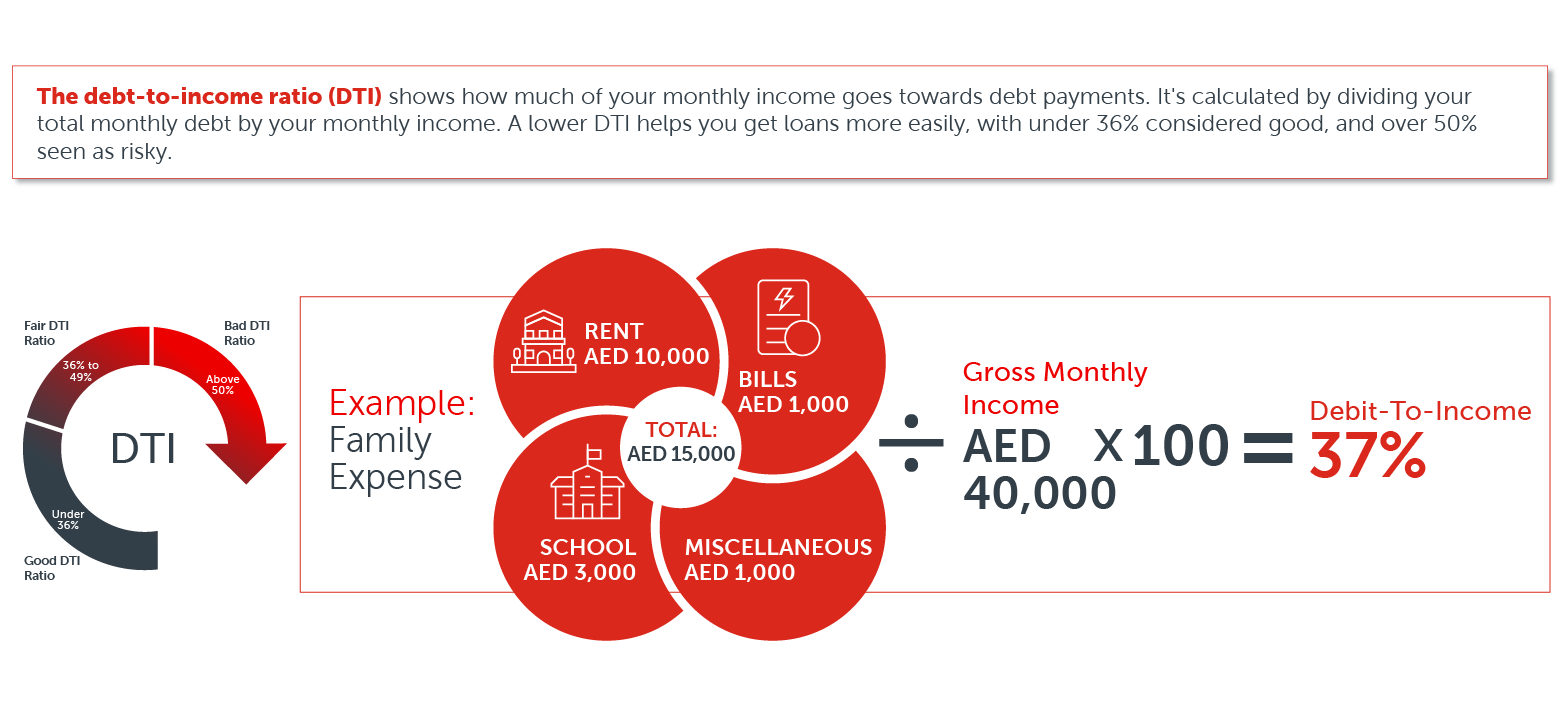
What is the Debt-to-Income Ratio? Your DTI is calculated by dividing your total monthly debt payments by your gross monthly income. The result is a percentage that shows how much of your income is committed to debt obligations. A lower DTI reflects a healthier balance between your income and debt levels. Financial institutions frequently use this metric to evaluate your capacity to manage monthly payments and repay debts.
How to calculate your debt-to-income ratio
- List your monthly debt payments – include all recurring obligations such as rent or mortgage payments, loans, bills, and other outstanding debts.
- Calculate your gross monthly income – this represents your total income before taxes and deductions.
- Divide and multiply – divide your total monthly debt by your gross monthly income, then multiply the result by 100 to express it as a percentage.
What do your DTI results mean?
- Good DTI (Under 36%) – reflects a healthy balance between debt and income. This ratio makes it easier to secure loans and benefit from favorable interest rates.
- Fair DTI (36% to 49%) – indicates a higher debt burden relative to income, potentially making it more challenging to obtain loans.
- High DTI (Above 50%) – suggests a financially risky situation, making it difficult to secure new loans and signaling a need to focus on reducing existing debt.
Why is DTI important?
Understanding your DTI is essential for making informed financial decisions. It influences your ability to:
- Obtain loans – lenders assess your DTI to determine whether you can manage additional debt responsibly.
- Manage finances – a lower DTI allows more of your income to be allocated towards savings, investments, or other financial goals.
- Plan for the future – monitoring your DTI helps you adjust your budget, manage debt effectively, and improve your overall financial health.
By calculating and regularly monitoring your DTI, you can take proactive steps to reduce debt and enhance your financial situation, ensuring long-term stability and security for you and your family.
Tags: Family Finances Infographics Debt management Debt to income ratio Achieving financial stability Calculating DTI