
 Letters spacing
 Line height
 Default
 Big
Big More big
 Default
 Black & White
Building Wealth Balancing risk and securing returns through bonds investing

srchThumbnail:/en/Images/investing-inbonds-200x200_tcm41-561947.webp
While investor attention is often focused on equity markets and stocks, bond markets offer a more nuanced risk-return dynamic and are often better indicators of the health of the global economy. Bonds are also often misunderstood, yet they play a vital role for investors by helping balance portfolios and offering income and investment diversification.
The different types of bonds
There are many types of bonds. Fundamentally, they are structured commitments by borrowers to repay lenders over time with interest.
| Government bonds | The most common type, issued by sovereign nations to fund various commitments, including public infrastructure. In the United States (U.S.), they are called Treasury bonds and usually carry low risk, particularly when backed by stable governments with strong credit ratings. |
| Corporate bonds | Issued by companies looking to finance growth, acquisitions or day-to-day operations. The risk and return of these bonds can vary significantly. For example, a bond from an established company in a developed economy presents different implications compared to one from a start-up in an emerging market. |
| Sukuk | An Islamic bond that does not involve interest payments, which are prohibited under Shari’ah law. Instead, Sukuks are structured around shared ownership in assets, lease agreements or profit-sharing arrangements, allowing investors to earn returns through asset-linked cash flows rather than fixed interest. According to the World Bank, the global sukuk market could soon be valued at U.S.$1 trillion. |
| Municipal bonds | Issued by government entities (e.g., cities, states). These are considered low risk, often backed by the taxing authority of the issuing municipality, which provides a degree of security. |
| Sustainable bonds | The environmental, social and governance (ESG) bond market has grown significantly in recent years. These bonds are issued to fund projects that support energy transition, reduce greenhouse gas emissions or advance social causes. According to the Institute of International Finance, the ESG debt universe expanded by over 20% in 2024 to reach U.S.$7.3 trillion. |
| Perpetual bonds | Bonds that do not have a maturity date and pay interest indefinitely. Some may include a callable feature, allowing the issuer to redeem the bond at a predetermined price after a certain period. |
| Complex bonds | Issued by governments, corporations or other entities, these bonds often include embedded options that give the issuer additional control over cash flows, maturity dates or obligations. Investors should fully understand these features before investing. |
Each of these bonds serves a different purpose and caters to investors with varying risk appetites, financial goals and time horizons.
Understanding credit ratings
Global agencies such as Standard & Poor’s (S&P) Global Ratings, Moody’s Investors Service and Fitch Ratings assess the financial health of companies and bond issuers using financial and non-financial data, including management interviews. The goal is to provide a benchmark for investors to assess the creditworthiness of an issuer or issuance.
Credit ratings are the outcome of these assessments. For example, U.S. Treasury bonds and those issued by developed countries like Canada and Germany are considered “safe” or “highly rated” due to their fiscal strength and strong track record of repayment.
Safer bonds typically offer lower yields than riskier bonds issued by entities with weaker credit histories or limited track records.
The key role of bonds in managing risk
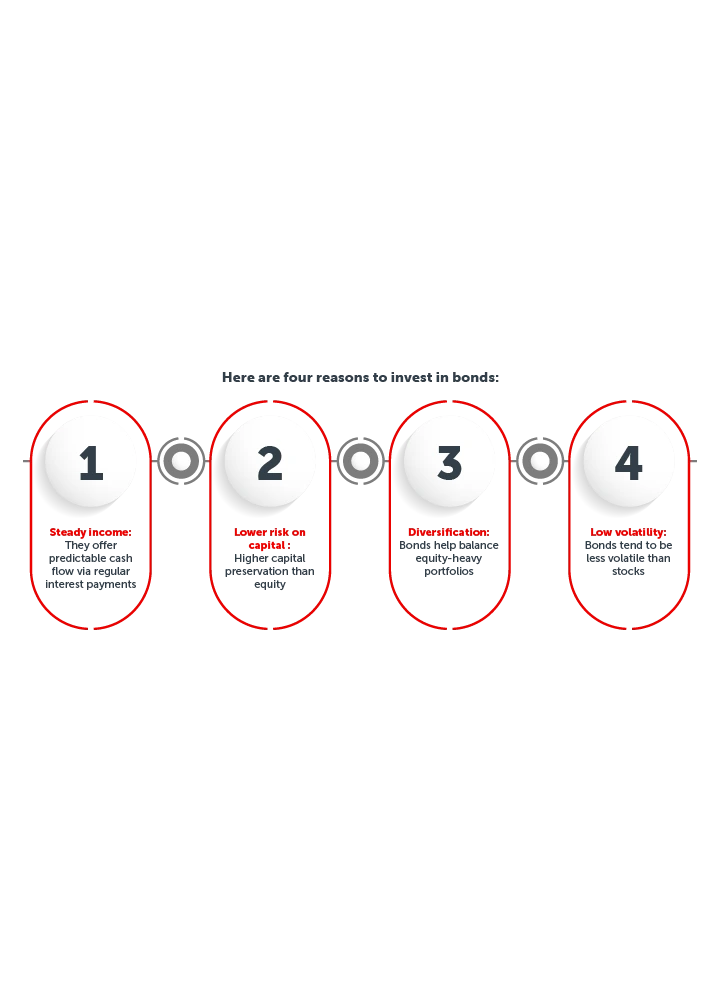
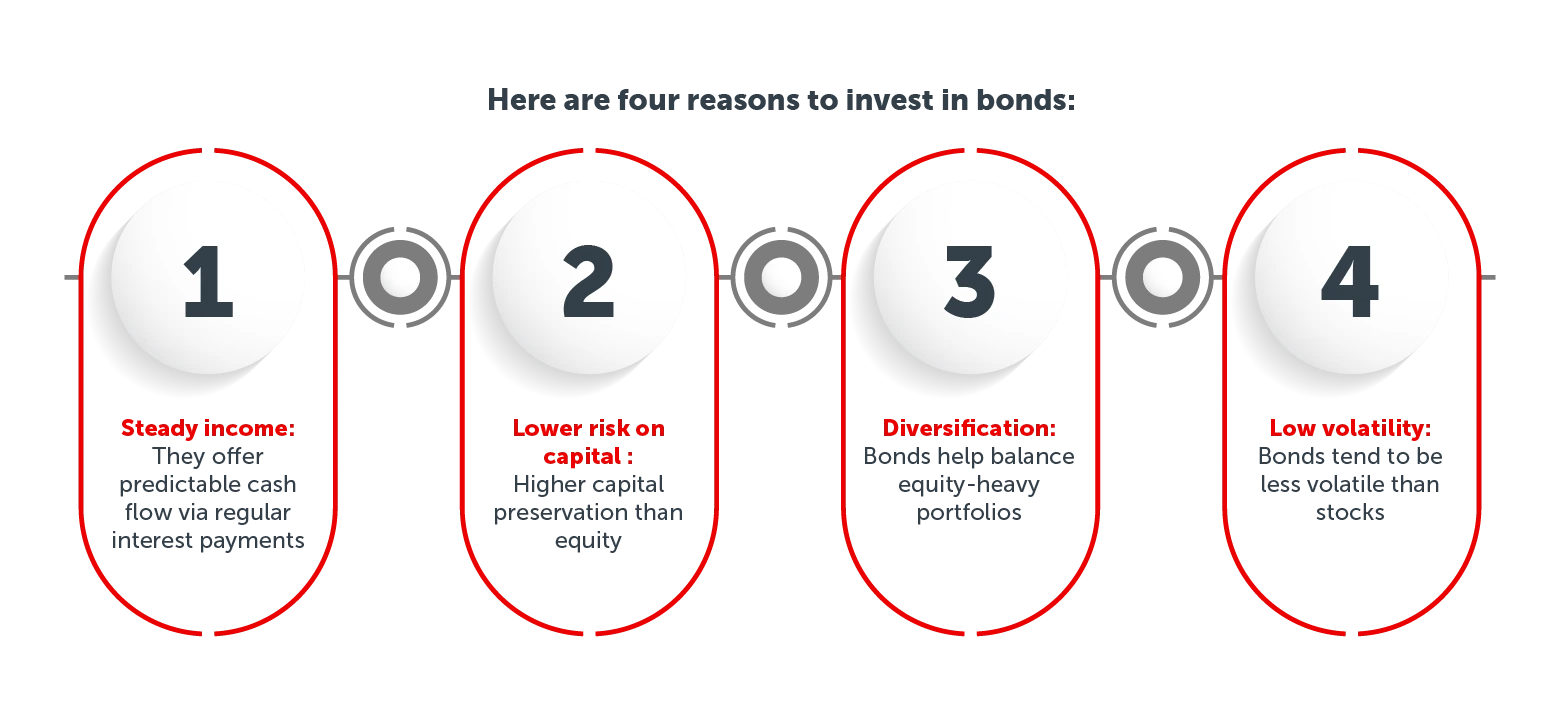
The relative safety of bonds makes them a useful counterbalance to equity markets. While stocks generally offer higher returns (from 1997 to 2024, the S&P 500 returned an annualised average of 9.7%, compared to 4.1% for the U.S. Aggregate Bond Index, bonds help reduce portfolio volatility. They also play a crucial role in capital preservation during periods of market downturn.
Overview of the global and UAE bond markets
The global bond market stands at approximately U.S.$130 trillion, surpassing the global equity market valued at around U.S.$110 trillion. The U.S. Treasury market alone represents a significant portion of global bond issuance.
The United Arab Emirates (UAE) is one of the largest U.S. dollar bond issuers in emerging markets (excluding China), accounting for 8.9% of total issuance in 2024, second only to Saudi Arabia (17.4%) and Brazil (9.4%), according to Fitch Ratings. The UAE’s bond market is projected to exceed U.S.$300 billion by mid-2025.
Recent reforms in the UAE are improving market access and transparency. Initiatives such as the listing of local currency bonds on Nasdaq Dubai and efforts to deepen the dirham-denominated bond market are making it easier for investors to participate. As the UAE positions itself as a regional financial hub, particularly in sustainable and green finance, its bond market is expected to grow in both size and sophistication.
What to consider when investing in bonds
Bonds can play a crucial role in an investment portfolio. Depending on your risk appetite, bonds could account for 10% to 60% of your overall investments. A general rule of thumb is to allocate 10–20% in your 30s, 20–30% in your 40s, and 30–50% in your 50s to protect accumulated wealth as you approach retirement.
Here are four important questions to ask a financial adviser before investing in bonds:
- What role will bonds play in my overall portfolio strategy?
- What are the credit risks and other risks associated with the bonds you are recommending?
- How sensitive is the bond to interest rate changes?
- What are the costs, tax implications and liquidity considerations?
The answers will help determine how bonds can support your long-term financial strategy.
To learn more, please contact your certified Relationship Manager.
Related resource
What investors need to know about buying a bond,
please click here.
Glossary
For Glossary of terms, abbreviations and explanations on investments, please visit adcb.com/invglossary.
Wealth Management solutions
Discover reliable, innovative Wealth Management solutions. Learn more
Disclaimer
ADCB’s products and services are subject to Consumer Banking Terms and Conditions. Abu Dhabi Commercial Bank PJSC ("ADCB", "The Bank") is licensed by the Central Bank of the United Arab Emirates under license number 13/2461/2005 to provide banking services to its clients, and by the Securities and Commodities Authority to promote investment securities and provide investment related services under license number 601001.
This webpage is for information and illustrative purposes only and does not constitute any form of advice, commitment or engagement on behalf of the Abu Dhabi Commercial Bank and any of its subsidiaries including ADCB Asset Management Limited ("ADCB Group"). It should not be construed as an offer or solicitation to buy or sell any investment products, nor is it to be considered as personalized investment advice. It should be read in conjunction with applicable documents and respective terms and conditions for potential investor to understand the terms and information contained therein. Persons receiving this email are instructed to discuss it with their professional legal, financial and tax advisors before they make any financial commitments and shall be deemed to have made a reasonable assessment of the potential risks and rewards in making such a commitment. ADCB Group does not guarantee any third party service provider, and investors invest at their own risk and bear all risks involved in any product purchased. ADCB Group will not hold any responsibility for the outcome of any investment decisions taken. Past performance does not guarantee future results. Investment products are not Bank deposits and are not guaranteed by the ADCB Group, they are subject to investment risks, including possible loss of the principal amount invested. Please refer to ADCB Wealth Services Terms and Conditions and/or to ADCB Asset Management Limited Terms and Conditions.
Tags: Nearing Retirement Entrepreneurs Growing Your Savings Growing Your Business Investing for Growth

