
 Letters spacing
 Line height
 Default
 Big
Big More big
 Default
 Black & White
Building Wealth Investing in Mutual Funds

srchThumbnail:/en/Images/investing-in-mutual-funds-200x200_tcm41-554507.webp
How to invest in Mutual Funds?
Mutual funds are an investment option available for individuals looking to grow their wealth. Whether you are a beginner or just seeking a clearer understanding this article will break down the basics of Mutual Funds in simpler terms. Moreover, a mutual fund is an investment vehicle that pools money from many investors and invests it in a diversified portfolio of securities such as stocks, bonds, etc. Each mutual fund unit represents an investor’s part ownership in the fund.
Benefits of investing in Mutual Funds
Mutual funds are a popular choice among investors because they generally offer advantages such as professional fund management, diversification to lower investment risk, affordability with relatively low initial investments and liquidity as investors can easily redeem their units at any time.
Diversification
Mutual funds give you an efficient way to diversify your portfolio thereby reducing the impact of poor performance by a single investment. Diversification helps mitigate risk and stabilize returns.
Professional Management
Mutual funds are managed by full time relationship managers who have the expertise, resources and experience to invest and manage the portfolio (saving you time and effort).
Affordability
You can start investing in Mutual Funds with relatively small amounts.
Liquidity
Generally, you can sell units of open-ended mutual fund schemes on any day, providing you easy access to your money.
Types of Mutual Funds
- Equity Funds - invest mainly in company stocks, aiming to provide long-term growth. In exchange for more growth potential, however, you are likely to experience more ups and downs in the value of your investment.
- Bond Funds - invest primarily in fixed-income securities such as government, municipal, corporate, and other debt instruments and are generally considered less risky than the equity funds.
- Index Funds - offer a portfolio to match or track the components of a financial market index such as the S&P 500, providing broad market exposure, low operating expenses, and low portfolio turnover, ideal for more conservative investors.
- Sector Funds - concentrate on a specific industry such as technology or healthcare. Because of their narrow focus, they offer less diversification, and hence higher risk.
- Money Market Funds – invest in debt securities with short maturities and minimal credit risk and are among the lowest-volatility types of investments.
- Others – include ESG funds, commodity funds and multi-asset funds.
- Target Dated Funds – designed to age with you by automatically rebalancing your portfolio from growth investments toward more conservative ones as retirement nears.

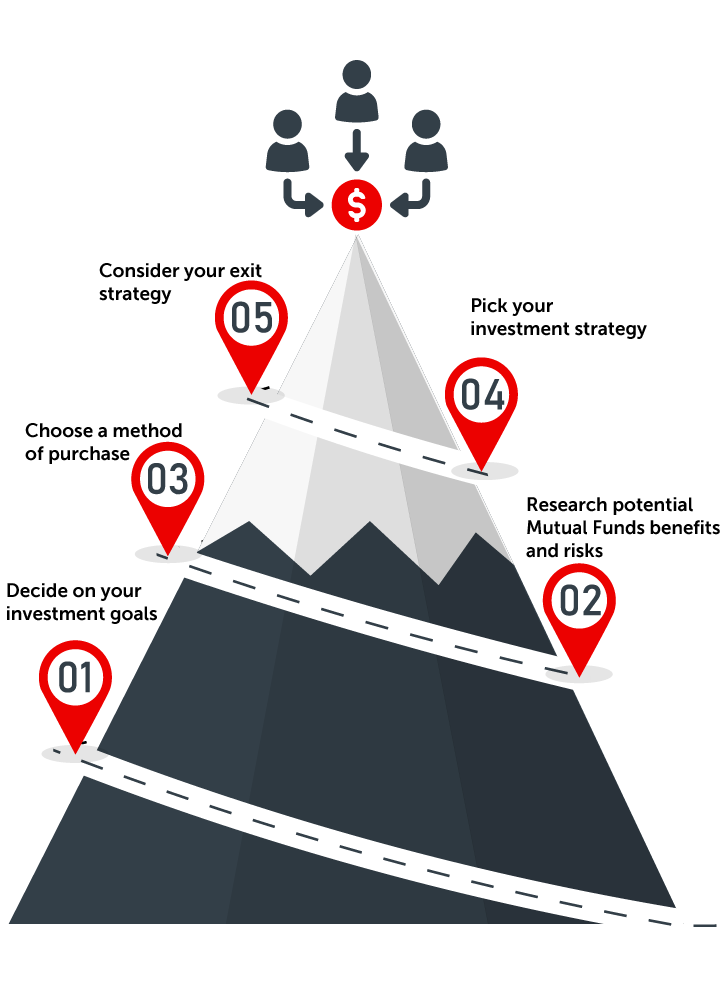
Step-by-step guide to investing in Mutual Funds
1. Decide on your investment goals whether short or long term
- First, identify your financial goals. Are your goals long term? like retirement, child’s education etc. or short term like – buying a house, car etc.
- Next, identify your risk tolerance which is the amount of volatility and loss you are willing to accept in your portfolio as an investor.
2. Research potential Mutual Funds based on your investment goals and risk tolerance
- Look at the fund’s performance against the market over a longer period, your budget, and costs of investment in terms of fees as well as the fund’s active or passive management strategy.
- When evaluating a fund’s performance, it helps to compare it to similar funds and widely followed benchmarks like the Standard & Poor's 500 index. Use a longer period, such as three- and five-year returns.
3. Choose a method of purchase
- Most investors opt to buy Mutual Funds through an online brokerage, which usually offer a broad selection of funds.
- You can also buy directly from the company that created the fund, but doing so may limit your choice of funds.
- Another option is to work with a traditional financial advisor to purchase funds who can assist you in portfolio construction over long term.
- You can also reach out to your relationship manager at a bank or financial institution, to discuss your financial goals.
4. Investment Strategy
- Decide whether you want to invest a lump sum investment or make regular contributions through a Systematic Investment Plan.
- You may also plan to review your investments on a regular basis. This will give you a chance to rebalance your portfolio and make sure that it matches the level of risk you want to take on to meet your goals.
5. Consider your exit strategy
- You will eventually want to sell your mutual fund shares to pay for your financial goals. That may include paying a fee to your broker and potentially taxes on any capital gains depending on the jurisdiction you are in.
Mutual funds offer an accessible and diversified way for individuals to invest in financial markets. With different types of funds catering to different investment objectives, and professional management to guide your investments. Mutual Funds are a valuable addition to any well-rounded investment strategy.
It is critical to conduct a thorough research and assess your risk profile and align your investments with your financial goals, before making any investment decision.
Related resources
Invest with confidenceGlossary
For Glossary of terms, abbreviations and explanations on investments, please visit adcb.com/invglossary.
Wealth Management solutions
Discover reliable, innovative Wealth Management solutions. Learn more
Disclaimer
ADCB’s products and services are subject to Consumer Banking Terms and Conditions. Abu Dhabi Commercial Bank PJSC ("ADCB", "The Bank") is licensed by the Central Bank of the United Arab Emirates under license number 13/2461/2005 to provide banking services to its clients, and by the Securities and Commodities Authority to promote investment securities and provide investment related services under license number 601001.
This webpage is for information and illustrative purposes only and does not constitute any form of advice, commitment or engagement on behalf of the Abu Dhabi Commercial Bank and any of its subsidiaries including ADCB Asset Management Limited ("ADCB Group"). It should not be construed as an offer or solicitation to buy or sell any investment products, nor is it to be considered as personalized investment advice. It should be read in conjunction with applicable documents and respective terms and conditions for potential investor to understand the terms and information contained therein. Persons receiving this email are instructed to discuss it with their professional legal, financial and tax advisors before they make any financial commitments and shall be deemed to have made a reasonable assessment of the potential risks and rewards in making such a commitment. ADCB Group does not guarantee any third party service provider, and investors invest at their own risk and bear all risks involved in any product purchased. ADCB Group will not hold any responsibility for the outcome of any investment decisions taken. Past performance does not guarantee future results. Investment products are not Bank deposits and are not guaranteed by the ADCB Group, they are subject to investment risks, including possible loss of the principal amount invested. Please refer to ADCB Wealth Services Terms and Conditions and/or to ADCB Asset Management Limited Terms and Conditions.

Did you know?Mutual Funds offer professional portfolio management
Knowledge quiz What is a key benefit of Mutual Funds?
Tags: Nearing Retirement Entrepreneurs Growing Your Savings Growing Your Business Investing for Growth

