
 Letters spacing
 Line height
 Default
 Big
Big More big
 Default
 Black & White
Building Wealth
Trader or investor?
How to find the right path for your money mindset

srchThumbnail:/en/Images/trading-or-investing-200x200_tcm41-565459.webp
Are you in it for the long haul or the quick wins?
Trading versus Investing: Which strategy aligns with your financial goals?
Stepping into the world of financial markets? One of the first questions to ask is: ‘Do you see yourself as a trader or an investor?’ This distinction is more than just semantics; it shapes your mindset, defines your risk appetite, and determines how much time and effort you’re willing to commit to managing your money. Let’s break it down.
Trading versus Investing: What’s the real difference?
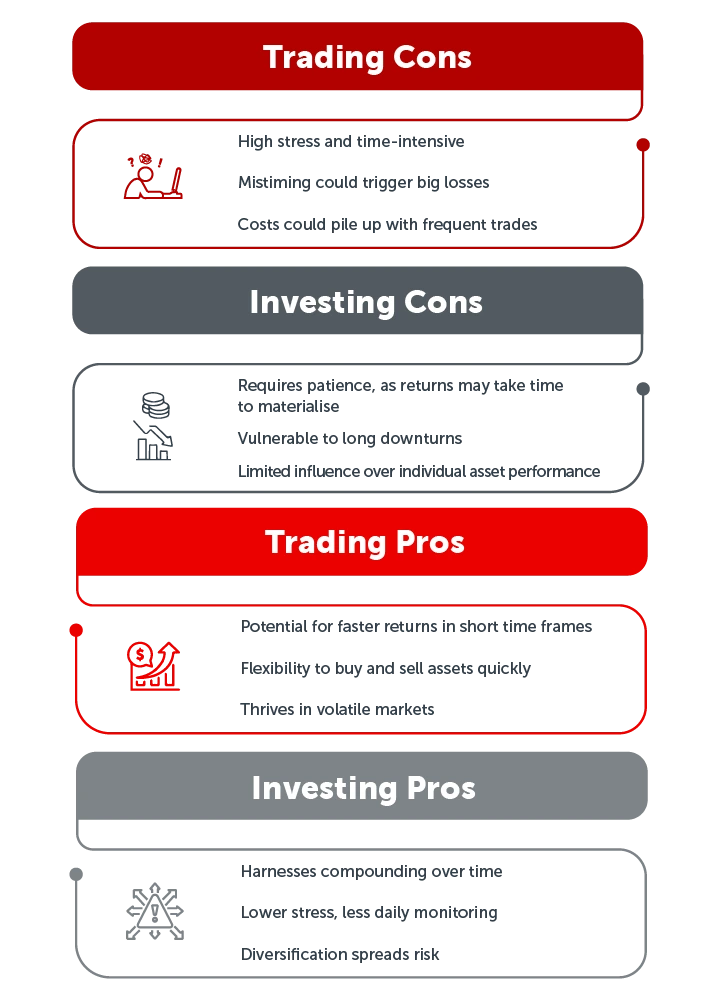
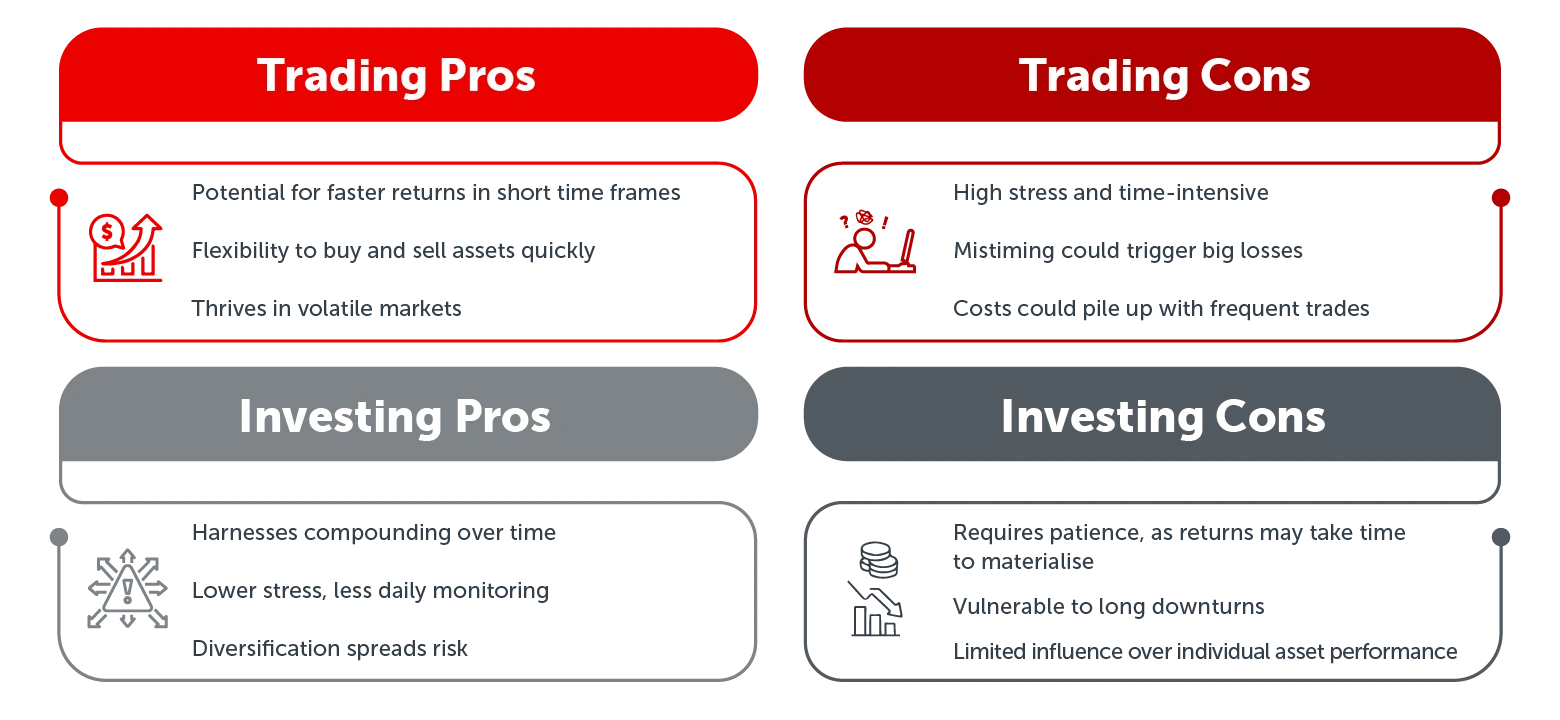
The difference lies in time horizon and approach:

How long-term investing builds wealth
Investing is a long-term strategy focused on building wealth gradually. It means buying assets—such as stocks, bonds, exchange traded funds, unit trusts or property—with the intention of holding them for years, even decades. The goal is to benefit from compound growth over time, making patience and consistency your greatest allies.

Trading is a short-term tactic aimed at profiting from market fluctuations
Trading, on the other hand, is about speed and precision. Traders actively buy and sell financial instruments—like stocks, options, or currencies—within short time frames, sometimes minutes or days. The aim is to leverage price movements and market volatility to generate quick returns, rather than holding onto assets for the long haul.
Both approaches can be profitable, but they demand very different skills, tools, and mindsets.
What’s your money mindset?
Markets don’t just test your portfolio; they test your emotional resilience.
- Investors need patience, discipline, and a tolerance for monotony. Holding through downturns requires faith that markets rise over time. If you’re comfortable with routines and can resist the urge to constantly check prices, investing may suit your temperament.
- Traders, on the other hand, thrive on action. They enjoy analysing charts, reacting to news, and taking calculated risks. But this intensity can be emotionally taxing, requiring the ability to absorb losses and navigate sharp market swings.
Neither mindset is superior, it’s about what suits you. DIY (do-it-yourself) traders may enjoy managing their own portfolios, while others may prefer a “set and forget” approach or rely on financial advisers.
What’s your risk tolerance?
Investing typically offers a smoother journey. A diversified portfolio helps spread risk and cushions against market volatility. However, t’s not risk-free, bear markets, recessions, and stagnation periods are part of the journey.
Trading is inherently more volatile. Positions are often concentrated and short-lived, amplifying both gains and losses. A few misjudged trades can significantly impact your account. Your comfort with volatility will guide your choice.
What’s your time horizon?
Investing is measured in years or decades. It rewards those who can let time and compounding quietly do the work. If you’re saving for retirement, a child’s education, or generational wealth, this approach aligns well. Trading demands constant attention. Even a full-time job can interfere. If you lack the bandwidth to monitor markets daily or the emotional agility to act swiftly, you may struggle to keep pace. Your calendar, not just your wallet, determines whether investing or trading is the better fit.
What are your financial goals?
If your goal is long-term stability, retirement income, family security, or financial independence, investing is the natural choice. It builds wealth over time with less daily stress. Meanwhile, if your aim is to generate active income or exploit short-term opportunities, trading may be more suitable. Traders focus on weekly or quarterly gains rather than long-term planning. Being clear about your goals helps avoid the costly mistake of applying the wrong strategy to the wrong ambition.
What tools support trading or investing?
Banks, brokerage platforms, and financial websites offer a wide range of tools tailored to both strategies.
- Investors rely on fundamentals - earnings reports, dividends, balance sheets, and long-term trends. Their toolkit includes low-cost index funds, dividend reinvestment plans, and pound-cost averaging.
- Traders use technical analysis and real-time data. Their toolkit includes charting platforms, indicators like moving averages, stop-loss orders, and sometimes leverage & options to amplify trades (for advanced strategies).
A dual approach could offer the best of both worlds if managed wisely
Many successful investors strike a balance by allocating, for instance, 80% to long-term investments for stability and growth while keeping aside 20% for short-term trades to capitalize on timely opportunities. This approach allows you to explore opportunities without compromising your financial foundation.
Ultimately, the choice between trading and investing isn’t about choosing the “right” option—it’s about choosing what aligns you’re your mindset, risk tolerance, time commitment, and financial goals. Whether you are drawn to the steady discipline of investing, the dynamic pace of trading, or a hybrid approach, clarity and consistency will help you navigating the markets with confidence.
To understand details about investing and trading, please speak to a certified Relationship Manager.
Glossary
For Glossary of terms, abbreviations and explanations on investments, please visit adcb.com/invglossary.
Wealth Management solutions
Discover reliable, innovative Wealth Management solutions. Learn more.
Disclaimer
ADCB’s products and services are subject to Consumer Banking Terms and Conditions. Abu Dhabi Commercial Bank PJSC ("ADCB", "The Bank") is licensed by the Central Bank of the United Arab Emirates under license number 13/2461/2005 to provide banking services to its clients and by the Securities and Commodities Authority to promote investment securities and provide investment-related services under license number 601001.
This webpage is for information and illustrative purposes only and does not constitute any form of advice, commitment or engagement on behalf of the Abu Dhabi Commercial Bank and any of its subsidiaries, including ADCB Asset Management Limited ("ADCB Group"). It should not be construed as an offer or solicitation to buy or sell any investment products, nor is it to be considered as personalised investment advice. It should be read in conjunction with applicable documents and respective terms and conditions for potential investors to understand the terms and information contained therein. Persons receiving this email are instructed to discuss it with their professional legal, financial and tax advisors before they make any financial commitments and shall be deemed to have made a reasonable assessment of the potential risks and rewards in making such a commitment. ADCB Group does not guarantee any third-party service provider, and investors invest at their own risk and bear all risks involved in any product purchased. ADCB Group will not hold any responsibility for the outcome of any investment decisions taken. Past performance does not guarantee future results. Investment products are not bank deposits and are not guaranteed by the ADCB Group, they are subject to investment risks, including possible loss of the principal amount invested. Please refer to ADCB Wealth Services Terms and Conditions and/or to ADCB Asset Management Limited Terms and Conditions.

Did you know?How retail investors are shifting strategies
Knowledge quiz You prefer to monitor markets daily, react quickly to news, and make fast decisions. Which strategy are you most likely suited for?
Tags: Nearing Retirement Entrepreneurs Growing Your Savings Growing Your Business Investing for Growth

